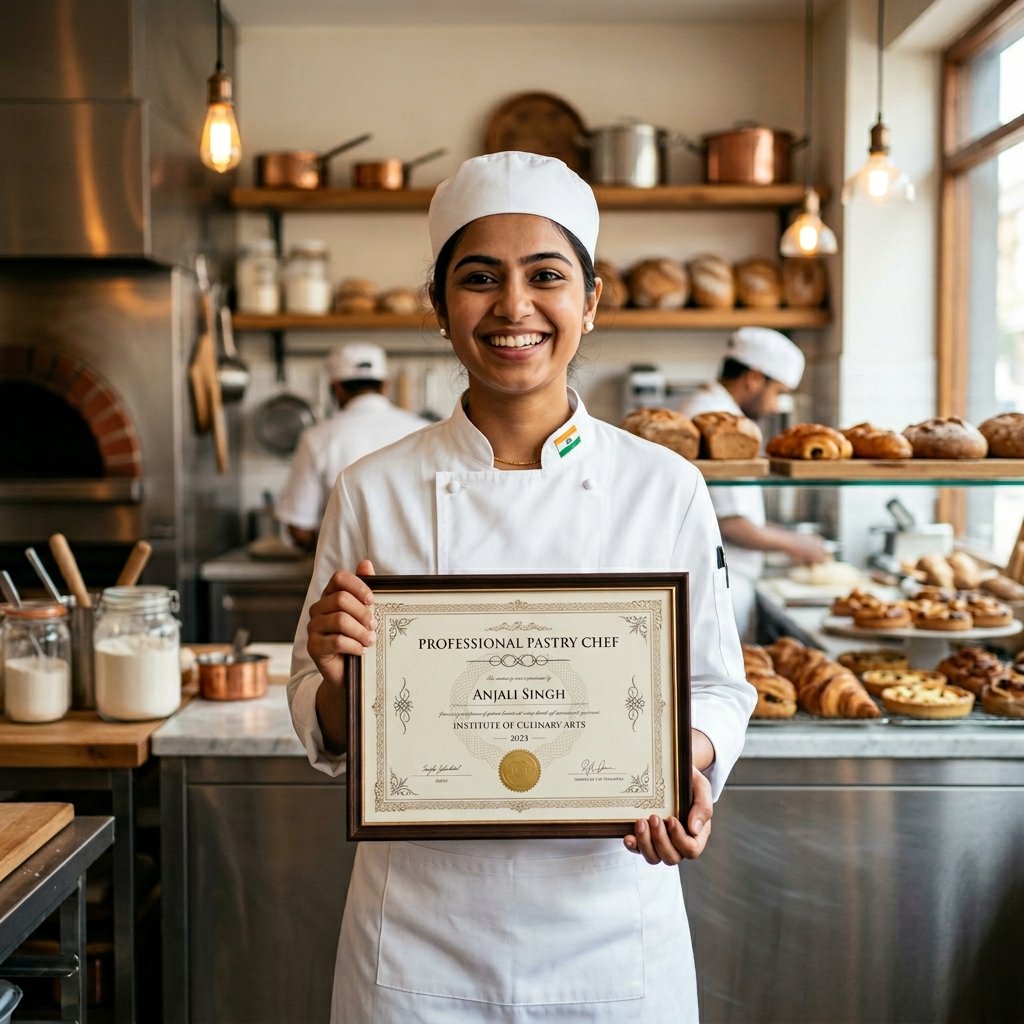
India's home bakery market is projected to cross ₹8,000 crore by 2027. Whether you're in Bangalore, Mumbai, Jaipur or Guwahati — here's everything you need to know about baking education in your city, plus how to choose the right school.
India's relationship with baked goods has transformed dramatically in the last decade. What was once dominated by industrial breads and basic cakes has evolved into a premium artisan market — driven by Instagram culture, rising disposable incomes, gifting traditions, and a massive shift toward home-based businesses.
The numbers tell the story: there are an estimated 3.2 million active home bakers in India as of 2025, with the organised bakery market growing at 9.7% CAGR. And yet, professional baking education has not kept pace. Most cities have just a handful of certified pastry schools — creating a genuine shortage of qualified professional bakers.
The career opportunity is clear: certified professional bakers who understand both technique and business are in short supply, in every major Indian city. This guide covers 26 cities where the demand is strongest.
Click your city for a complete local guide: top schools, fees, market opportunity, and career outlook.
Karnataka
Punjab/Haryana
Gujarat
Punjab
Tamil Nadu
Uttarakhand
Assam
Rajasthan
West Bengal
Punjab
Maharashtra
Uttar Pradesh
Haryana
Maharashtra
Jharkhand
Gujarat
Madhya Pradesh
Tamil Nadu
Madhya Pradesh
Kerala
Uttar Pradesh
Tamil Nadu
Bihar
Maharashtra
Andhra Pradesh
TN Campus Here
India's bakery market isn't monolithic — each region has distinct food cultures, ingredient preferences, price points, and competitive dynamics. Understanding these differences is critical for anyone planning a baking career or business. Here's what the opportunity looks like across India's major regions.
North India is the largest market for baked goods in the country, driven by a strong gifting culture, wedding season demand, and rapidly expanding café culture in tier-2 cities. Delhi NCR alone accounts for an estimated 18% of India's organised bakery market.
Delhi NCR (including Noida and Gurugram) is where the highest concentration of professional baking schools exists. The city has multiple professional-grade academies, including Truffle Nation, which operates its flagship campus in Sainik Farm. Delhi bakers benefit from a massive local market: the wedding cake industry alone is worth an estimated ₹200 crore annually in NCR. Average order values for custom cakes range from ₹2,500 to ₹15,000, with premium wedding cakes commanding ₹25,000 and above.
Jaipur and Lucknow represent the fastest-growing tier-2 markets for baking education. Jaipur's tourism-driven economy supports a thriving café and bakery scene, particularly along MI Road and C-Scheme. Lucknow's market is driven by its deep-rooted food culture — while traditionally focused on Awadhi cuisine, the city has seen a 40% increase in standalone bakeries between 2022 and 2025. Professional training options in both cities remain limited, creating a significant gap between demand and supply of skilled bakers.
Chandigarh, Amritsar, and Ludhiana form the Punjab bakery belt — a region with exceptionally high per-capita bakery consumption. Punjabi culture's celebration-heavy calendar (weddings, Lohri, Diwali) drives consistent year-round demand for baked goods. Home bakers in Punjab routinely report monthly revenues of ₹40,000–₹1,20,000, with the biggest revenue spikes during November-February wedding season.
Dehradun is an emerging market with unique advantages: lower rent means lower overhead for bakery startups, and the city's growing tourist and student population provides a ready customer base. Professional training options in Dehradun are extremely limited, making it an excellent city for trained bakers to establish first-mover advantage.
Western India presents a diverse and lucrative baking market, from Mumbai's premium café culture to Gujarat's massive vegetarian/eggless demand.
Mumbai is India's most competitive bakery market. The city has the highest concentration of artisan bakeries, cloud kitchens, and café chains in the country. Custom cake prices in Mumbai average 20-30% higher than other metros, with premium 2-tier cakes selling for ₹5,000–₹12,000. However, competition is fierce — Mumbai has over 15 baking academies of varying quality. The key differentiator for Mumbai bakers is specialisation: those who develop a niche (vegan, sugar-free, French pastry, or wedding cakes) outperform generalists significantly.
Pune and Thane are Mumbai's spillover markets — growing rapidly as young professionals and families migrate for more affordable living. Pune's IT population drives demand for premium baked goods, and the city's student culture supports a thriving café economy. Thane, with 1.8 million residents, has surprisingly few professional bakeries, creating a genuine gap for trained bakers.
Ahmedabad and Vadodara are critical markets because of Gujarat's predominantly vegetarian population. Eggless baking isn't just a nice-to-have in Gujarat — it's a requirement for 70%+ of customers. Bakers trained in 100% eggless techniques (like those from Truffle Nation) have an enormous advantage in these cities. The Gujarati gifting culture, particularly during Diwali and wedding season, drives some of the highest bakery revenues in the country.
Indore, recently named India's cleanest city for the seventh consecutive year, has a food culture that rivals any metro. The city's famous street food scene is evolving to include artisan bakeries and modern cafés, and locals' willingness to pay for quality food means higher margins for trained bakers. Professional baking education in Indore is virtually non-existent, making trained professionals highly sought after.
South India's bakery market is characterised by strong coffee culture (which supports café-bakery models), high per-capita income in tech cities, and distinct regional flavour preferences.
Bangalore is India's café capital. The city's tech workforce drives premium pricing: a single-origin sourdough loaf sells for ₹350–₹600 in Indiranagar or Koramangala, compared to ₹150–₹250 in most other cities. Bangalore has several established baking schools, but the demand for trained bakers still far outstrips supply. Cloud kitchen bakeries have been particularly successful here, with several Bangalore-based home bakers scaling to ₹2L+/month through Swiggy and Zomato.
Chennai presents a unique opportunity. The city's traditional sweet culture (think Aavin milk cakes and filter coffee) is rapidly expanding to include French-influenced pastry and artisan bread. Chennai's growing IT corridor (OMR, Sholinganallur) has created a new demographic of customers willing to pay premium prices. The eggless market is particularly strong here — Tamil Nadu has a large vegetarian population, and home bakers who specialise in eggless cakes dominate Chennai's Instagram baking scene.
Kochi is Kerala's bakery powerhouse. The state has one of the highest literacy rates and per-capita incomes in India, which translates to sophisticated food preferences. Kochi's Christmas cake market alone is worth crores, and the city's tourism industry (backwater resorts, boutique hotels) provides a year-round market for premium baked goods. Coimbatore and Madurai are emerging tier-2 markets with growing demand but very few trained professional bakers.
Eastern India has some of the most passionate food cultures in the country, and the baking market is growing rapidly — but professional training infrastructure is almost non-existent.
Kolkata is India's sweet capital. Bengalis have an unmatched love for sweets and baked goods, and the city's confectionery industry is massive. Kolkata's unique advantage: customers are willing to experiment. French pastry, artisan chocolate, and fusion desserts find enthusiastic audiences in neighbourhoods like Park Street, Salt Lake, and New Town. However, professional baking education in Kolkata is surprisingly limited given the city's food heritage.
Ranchi has emerged as an unexpected baking hotspot. Despite being a smaller city, Ranchi's search demand for baking education consistently outperforms much larger metros — a clear signal that the city has a hungry audience of aspiring bakers but almost no local training options. This is a classic first-mover opportunity.
Patna and Guwahati represent India's next wave of bakery markets. Bihar's population of 12 crore and Assam's growing urban middle class create enormous potential demand. Professional bakeries in these cities are rare, meaning trained bakers face almost zero competition. Home bakers in Patna regularly report being overwhelmed with orders, particularly during Chhath Puja and wedding season.
Bhopal and Visakhapatnam are mid-sized cities with growing urban populations and evolving food preferences. Bhopal's Royal Food Walk culture is expanding to include modern baking, and the city's large student population (MANIT, LNCT) creates a ready café customer base. Vizag's coastal location and growing IT sector (fuelled by the AP government's push for tech investment) are driving demand for premium food experiences.
What unites all these Central Indian markets is opportunity through scarcity. Professional baking training simply doesn't exist locally. The few trained bakers operating in these cities — many of whom trained at Truffle Nation in Delhi — have built thriving businesses with virtually no professional competition.
With dozens of baking schools across India, choosing the right one is critical. Here's a framework used by professionals to evaluate training programmes:
A 6-month course that covers 12 modules is more valuable than a 12-month course that repeats the same 5 modules. Ask for the complete module list before enrolling. Key modules to look for: breads and yeast products, laminated doughs (croissants, Danish), chocolate tempering, cake decoration, plated desserts, and — critically — business training (pricing, marketing, FSSAI registration).
This is the single biggest quality differentiator. A 1:8 ratio (like Truffle Nation) means you get personal feedback on every product. A 1:20 ratio means the instructor is demonstrating while most students watch. In a hands-on craft like baking, the difference is enormous. Ask specifically: "How many students per batch, and how many instructors are present during practical sessions?"
Any school can promise "100% placement." What matters is evidence. Ask for: alumni Instagram handles (to verify they're actually baking professionally), specific placement partners (hotel names, bakery names), and whether graduates launched their own businesses. A school with 5,000+ active graduates will have verifiable proof of outcomes.
Visit in person if possible. Professional training requires professional equipment: deck ovens (not just convection), a dedicated chocolate room with temperature control, proofing cabinets, commercial mixers, and adequate counter space per student. Many schools operate from converted apartments — fine for hobby courses, but inadequate for professional training.
In India, eggless baking is not optional. Over 30% of the Indian population is vegetarian, and the percentage is higher in Gujarat, Rajasthan, and many South Indian communities. A school that teaches primarily egg-based recipes is leaving you unprepared for the largest segment of the Indian market. Truffle Nation's 100% eggless curriculum ensures graduates can serve every customer segment.
The best schools don't stop at graduation. Look for: ongoing mentorship or alumni communities, placement support with active hiring partner networks, business launch guidance (for those starting their own bakeries), and recipe updates as trends evolve. A professional baking certificate from a respected institution carries weight for years — but ongoing community and support make the investment compound over time.
A common question we hear from prospective students: "What happens after I graduate?" The answer depends on your goals, but here are the five most common career paths for professionally trained bakers in India:
Income potential: ₹30,000 – ₹2,00,000/month
The most popular path. Start from your home kitchen with minimal investment (₹50,000–₹1,50,000 in equipment), build an Instagram following, and scale through word of mouth and delivery platforms. Many Truffle Nation graduates reach ₹80,000/month within their first year.
Income potential: ₹20,000 – ₹1,20,000/month
Hotels and restaurant chains hire pastry chefs at every level. Entry-level commis positions start at ₹18,000–₹25,000/month, with rapid progression to demi chef de partie (₹35,000–₹50,000) and chef de partie (₹60,000–₹1,00,000). Five-star hotels in metros offer the highest salaries.
Investment: ₹8,00,000 – ₹25,00,000
For those with the capital and ambition to open a physical space. A small-format bakery café in a tier-2 city can be launched for ₹8–12 lakhs. The average bakery café in India achieves breakeven in 8–14 months, with mature units generating ₹3,00,000–₹8,00,000 monthly revenue.
Investment: ₹2,00,000 – ₹5,00,000
The fastest-growing model. A delivery-only bakery requires less space, no front-of-house staff, and lower rent. Swiggy and Zomato have made it possible for bakers to reach thousands of customers without a storefront. Cloud kitchen bakers in metros report ₹50,000–₹1,50,000/month.
Income potential: ₹40,000 – ₹1,50,000/month
Experienced bakers build multiple income streams: custom cake orders, corporate gifting contracts, baking workshops (₹2,000–₹5,000 per participant), and social media content. Many combine 2-3 of these streams for a diversified and resilient income.
Income potential: ₹1,50,000 – ₹4,00,000/month
Dubai, Singapore, UK, and Australia actively recruit trained pastry chefs from India. Salaries are 3-5x higher than domestic positions. A professional certificate from a recognised Indian academy, combined with 1-2 years of domestic experience, is typically sufficient to qualify for international positions.
The Indian baking market is evolving rapidly. Understanding these trends will help you position yourself for maximum opportunity:
India is the world's largest market for eggless baked goods, and the trend is accelerating. What was once seen as a compromise ("eggless = inferior") has become a premium positioning — consumers now actively seek out eggless options for health, religious, and ethical reasons. Bakers trained in professional eggless techniques command higher prices and serve a broader market than those limited to egg-based recipes.
The artisan bread movement that transformed Western markets has arrived in India. Specialty sourdough loaves now sell for ₹300–₹600 in metros, and the market is expanding to tier-2 cities. Home bakers who master sourdough, focaccia, and ciabatta have a significant pricing advantage — bread margins are often higher than cake margins because ingredient costs are lower.
Over 80% of new home bakeries in India are launched through Instagram. Visual presentation skills — food photography, styling, reel creation — have become as important as baking skills for business success. The most successful home bakers invest 30-60 minutes daily in content creation, treating Instagram as their primary marketing channel. This is why professional courses that include business and marketing training (not just baking technique) produce more successful graduates.
Corporate gifting has become a major revenue stream for professional bakers. Diwali hampers, employee birthday cakes, event catering, and branded gift boxes generate consistent B2B revenue that smooths out seasonal fluctuations. Bakers who build corporate relationships early can generate ₹50,000–₹2,00,000 during peak gifting seasons (October-December).
Cities like Ranchi, Lucknow, Indore, and Kochi are experiencing the fastest growth in bakery demand. Lower competition, lower rent, and growing disposable income make these cities ideal for first-time bakery entrepreneurs. A professional baker in Ranchi or Patna faces 90% less competition than one in Mumbai — but charges only 15-20% less for comparable products.
Since 2017, Truffle Nation has been Delhi's most trusted professional pastry academy. With a campus in Sainik Farm, a 100% eggless curriculum, and an unmatched placement network, we've become India's benchmark for baking education.
Delhi, Bangalore, and Mumbai have the most established professional pastry schools. However, the best school for you depends on where you plan to build your bakery business — studying in your home city often makes more sense since you'll build local connections and a client base before you even graduate.
Short hobby courses range from ₹2,000–₹20,000. Professional diploma and certification programs typically range from ₹1,50,000 to ₹5,00,000+ depending on the school and duration. Truffle Nation's programs range from ₹1,85,000 (Six Week) to ₹3,65,000 (Diploma).
There are online baking courses available, but professional-level pastry training requires hands-on practice in a professional kitchen. Online courses are good for home baking basics; for a career-level outcome, in-person training with real kitchen time is essential.
Yes — strongly. The combination of India's growing cafe culture, premium gifting demand, and the Instagram-driven home bakery boom means certified professional bakers are in high demand. Graduates from Truffle Nation have built home bakery businesses generating ₹50K–₹2L/month within their first year.
A short baking course (typically 1–8 weeks) covers specific techniques or products — useful for hobby bakers. A professional diploma (4–6 months) covers the full professional curriculum: multiple product categories, advanced techniques, business skills, and often includes internship and placement support.
Truffle Nation's professional programs are in-person at our Delhi campus — because professional pastry training requires hands-on kitchen time. However, students from across India regularly relocate to Delhi for 1–5 months to complete the program, then return home to launch their bakery businesses.
Evaluate: (1) curriculum depth and module count, (2) student-to-mentor ratio — smaller batches mean more hands-on time, (3) placement/business support, (4) alumni outcomes — ask to speak with graduates, (5) kitchen facilities — visit in person if possible. Our free demo class lets you experience Truffle Nation before committing.
No prior experience is required at Truffle Nation. Our programs are designed to take students from beginner to professional level. Many of our graduates started with zero baking experience and went on to run successful bakeries.
Whether you train locally or at a national institute, these are the non-negotiable skills that separate successful professional bakers from hobbyists.
Bread is the foundation of professional baking. You need to understand yeast behaviour, gluten development, fermentation timing, and shaping techniques. From basic dinner rolls to sourdough, ciabatta, and brioche — a professional baker must be fluent in yeast-based products.
This is where many short courses fail — they skip bread entirely. Without bread skills, you cannot work in any professional bakery or hotel kitchen.
Croissants, Danish pastries, puff pastry, and other laminated doughs are among the most technically demanding products in a baker's repertoire. The process of folding butter into dough to create hundreds of flaky layers requires precision, temperature control, and practice.
Mastering lamination separates a professional from a home baker. In India, a baker who can produce perfect croissants has virtually no competition.
Tempering chocolate, making ganache, creating truffles, and using chocolate for decoration are essential professional skills. Chocolate commands premium pricing — a box of handmade truffles sells for ₹800-₹2,000 and takes less than 2 hours to produce.
Professional chocolate work requires understanding crystallisation, temperature curves, and humidity management. This is not something you can learn from YouTube.
Custom celebration cakes are the highest-revenue product for most home bakers. You need to master multiple frosting techniques (buttercream, cream cheese, ganache drip), fondant work, piping, colour theory, and structural engineering for tiered cakes.
A beautifully decorated 2-tier cake sells for ₹3,000-₹8,000 in India. This single skill can pay your rent every month.
Knowing how to bake is only half the equation. Knowing how to price your products profitably, market your business on Instagram, manage your food costs below 35%, register with FSSAI, and handle customer relationships is what turns baking skill into baking income.
Many talented bakers fail because they underprice their products. A good training program includes a comprehensive business module.
In India, eggless baking isn't optional — it's essential. Over 30% of the population is vegetarian, and the percentage is even higher in many communities in Nationwide. Professional eggless techniques use specific replacers, ratios, and methods to achieve the same texture, rise, and flavour as egg-based products.
Truffle Nation's 100% eggless curriculum ensures you can serve every customer in India, not just 70% of them.
Many people consider skipping formal training and learning from YouTube instead. While YouTube is excellent for hobby baking, it creates blind spots that cost real money in a professional setting.
Self-taught bakers typically: underprice their products by 30-40% (they don't know how to cost properly), waste 15-20% of ingredients due to inconsistency, struggle with large orders because they lack production planning skills, and plateau in quality because no one is correcting their technique.
Over a year, these inefficiencies cost far more than a professional course. A baker losing ₹10,000/month to underpricing and waste is losing ₹1.2 lakhs per year — nearly the cost of a Six Week Program.
Students from India consistently choose Truffle Nation for five reasons: (1) India's only 100% eggless professional curriculum, (2) 1 chef for every 8 students guarantees personal attention, (3) 5,000+ graduates and a nationally recognised certificate, (4) comprehensive business training included in every program, and (5) 400+ graduates placed in hotels and bakeries across India.
Our Delhi campus at Sainik Farm is accessible from all major Indian cities by flight. We help outstation students find accommodation and settle in. The investment is temporary — the skills and network last a lifetime.
Book a free demo session to visit our campus, meet our chef mentors, and attend a live baking class before making your decision.
Explore baking opportunities across India and read our comprehensive guides on building a baking career.